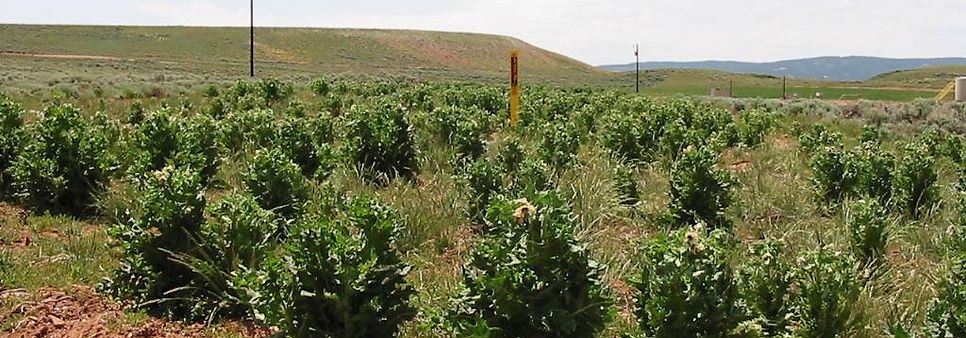
Black Henbane (Hyoscyamus niger L.)
Black henbane is an annual or biennial forb that grows from a stout taproot. In its first year, it forms a basal rosette of leaves. During the second year, it produces an upright flowering stem typically reaching about 3 feet tall, though it may grow as tall as 6 feet under favorable conditions.
Stems and leaves are gray-green and densely covered with sticky, greasy hairs that emit a strong, unpleasant (“fetid”) odor when crushed. Leaves are large—2 to 8 inches long and up to 6 inches wide—with shallow lobes or toothed margins and prominent pale mid-veins.
Flowering occurs from mid-spring through late summer. Flowers are borne on racemes and are large and showy, up to 2 inches across. Each flower is funnel-shaped with five lobes fused at the base. Petals range from pale cream or yellowish-green to brownish-yellow and are heavily veined with purple. The center of the flower is often deep purple to nearly black, giving the plant its common name.
The calyx forms a distinctive, urn-shaped capsule about 1 inch long. At maturity, a thickened lid pops off, releasing numerous small black seeds. The woody flower stalks and skeletal seed capsules often persist long after the rest of the plant has died, making mature plants easy to identify.
Black henbane contains the toxic tropane alkaloids hyoscyamine, scopolamine, and atropine in all plant parts. Although historically used medicinally, these compounds can be highly toxic—and potentially fatal—to humans, livestock, and wildlife. Alkaloids may also be absorbed through the skin, so care should be taken when handling the plant.
highly toxic—and potentially fatal—to humans, livestock, and wildlife

Quick ID
GuideLife Cycle:
• Annual or biennial
• Taproot
• Basal rosette first year
Height:
• Typically 3 feet (up to 6 feet)
Leaves:
• Gray-green with white mid-vein
• 2–8 inches long
• Lobed or toothed margins
• Sticky, hairy, foul-smelling
Flowers (Mid-Spring–Late Summer):
• Up to 2 inches wide
• Funnel-shaped, 5 lobes
• Cream to yellow with purple veins
• Dark purple to black center
Seeds/Fruit:
• Urn-shaped capsule (~1 inch)
• Lid pops off at maturity
• Numerous small black seeds
• Woody “skeleton” stems persist
Management Options
Prevention and cultural control practices should be emphasized whenever possible.
Because black henbane grows from a taproot, small infestations can often be controlled by hand pulling or digging, as long as the entire root is removed. Mechanical control, such as tilling or hoeing, is also effective when the taproot is cut at least 2 inches below the soil surface. Grazing is not advised due to the plant’s toxicity and the risk of livestock poisoning. Mowing or chopping will not eradicate established plants but may reduce seed production if done before seeds mature. Do not mow once seed capsules have formed.
For larger infestations, herbicide treatment may be necessary. Applications are most effective when made to rosettes in spring or fall, though bolting plants can also be treated. Flowering plants can be cut, and any remaining rosette or regrowth treated with herbicide to prevent reflowering and seed production. Always read and follow herbicide label directions before use. Contact Sublette County Weed & Pest for guidance on product selection, application rates, and timing.