


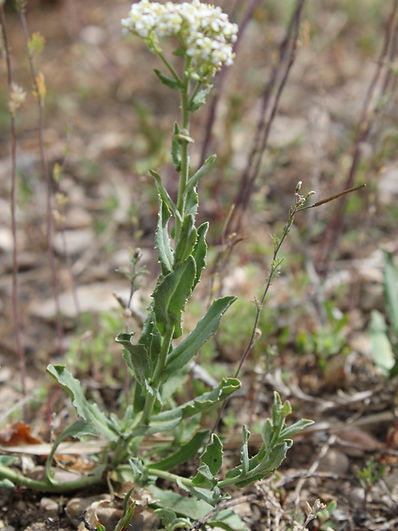
Hoary Cress, AKA Whitetop
(Cardaria draba & Cardaria pubescens (L.) Desv.)
Hoary cress is an early-season, herbaceous perennial that emerges in spring and rapidly forms dense patches. It produces multiple upright stems that can grow up to 2 feet tall. Stems are typically unbranched and covered with short hairs.
Basal leaves have petioles and form a rosette early in the season. Upper leaves are arranged alternately, are gray-green to blue-green in color, and clasp the stem with a distinct arrowhead shape. Leaves are softly hairy (pubescent), ranging from ½ to 4 inches long and 0.1 to 1½ inches wide. Basal leaves tend to be longer and narrower than those along the stem.
Hoary cress flowers from mid-spring through mid-summer. Flower clusters form at the ends of stems. In the bud stage, clusters resemble small broccoli heads and may appear bluish or purplish before opening. Individual flowers are small, white, and have four petals arranged in a cross shape, typical of the mustard family.
Seeds develop in small, heart-shaped to oval pods. Seeds are tiny and reddish-brown. The plant spreads aggressively through an extensive rhizomatous root system that can extend more than 10 feet deep.
Hoary cress foliage contains glucosinolates and is toxic to cattle.

Quick ID Guide
Life Cycle:
• Perennial
• Spreads by deep rhizomes
Height:
• Up to 2 feet tall
• Multiple upright, hairy stems
Leaves:
• Gray-green to blue-green
• Basal leaves with petioles
• Upper leaves are arrowhead-shaped and clasp the stem
• Softly hairy
Flowers (Mid-Spring–Mid-Summer):
• Bud stage resembles small broccoli heads
• Small white flowers with 4 petals
• Clustered at stem tips
Seeds/Fruit:
• Small, heart-shaped or oval pods
• Tiny reddish-brown seeds
Roots:
• Extensive rhizomatous system
• Can extend deeper than 10 feet

Management Options
Prevention and cultural control methods should be prioritized whenever possible to limit the spread and establishment.
The United States Department of Agriculture Animal and Plant Health Inspection Service (USDA APHIS) approved the release of a biological control agent, Aceria drabae, in Wyoming in 2022. This gall-forming mite has been released in Sublette County on test sites. Hand pulling or digging may be effective for very small patches, provided the entire taproot and lateral roots are removed. Because root fragments can resprout, efforts must be repeated throughout the growing season and continued for multiple years. Tillage may also reduce infestations if performed at 10-day intervals, with extreme care taken to prevent spreading root fragments. Grazing with sheep or goats can suppress seed production and weaken root reserves.
Can be toxic to livestock.
Large or well-established infestations are most effectively managed with herbicides. Spring applications during the bud (“broccoli”) stage provide the best control, though fall treatments may also help reduce root reserves. Always read and follow the herbicide label before application. Contact Sublette County Weed & Pest for assistance with product selection, rates, and application timing.
