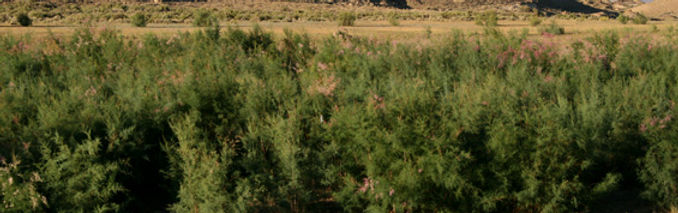
Saltcedar (Tamarix spp.)
Saltcedar is a deciduous, perennial shrub or small tree that aggressively invades riparian areas, displacing native vegetation and consuming large quantities of water. It may be branched from the base and typically grows between 5 and 25 feet tall.
Branches and stems are reddish-brown. Young stems are slender and flexible, while older bark becomes furrowed. Leaves are very small (1.5–3.5 mm long), blue-green, and scale-like, giving the plant a cedar-like or feathery appearance.
Saltcedar does not usually flower until its third year of growth. Flowers bloom from late spring through summer and are pink to white, forming in narrow racemes at the tips of branches. Individual flowers are very small and have five petals.
Seeds develop in small capsules and are tiny, black to brown, and similar in size to ground pepper. Each seed has a tufted pappus that allows it to disperse long distances by wind or water.
Saltcedar has a deep, spreading root system capable of extending 30 feet or more to reach groundwater, contributing to its ability to dominate riparian systems.

Quick ID Guide
Growth Form:
• Deciduous shrub or small tree
• 5–25 feet tall
• Often branched from the base
Leaves:
• Very small (1.5–3.5 mm)
• Blue-green
• Scale-like
• Cedar-like appearance
Stems & Bark:
• Reddish-brown stems
• Slender, flexible new growth
• Furrowed bark on older stems
Flowers:
• Pink to white
• Five petals
• Thin racemes at branch tips
• Blooms after the third year
Seeds:
• Tiny, black to brown
• Pepper-sized
• Tufted pappus for wind/water dispersal
Roots:
• Deep and spreading
• Can reach 30+ feet to water table
Management Options
Prevention and cultural control strategies should be prioritized. Clean, Drain, and Dry watercraft, including rafts, paddleboards, and waders, before moving between waterways—especially after visiting areas with known saltcedar infestations.
There are currently no biological control agents available for saltcedar.
.
Because saltcedar is a woody shrub or tree with a deep and extensive root system, mechanical and chemical methods should be combined for effective control. Small plants, particularly in sandy or gravelly soils, may be hand-pulled, ensuring the removal of as much root material as possible. Sites should be monitored repeatedly to confirm that rootstocks do not resprout.
Larger shrubs and trees should be controlled using the cut-stump method—cutting the trunk and immediately applying an appropriate labeled herbicide to the freshly cut surface. Cut-stump and related herbicide treatments are generally most effective in late summer or early fall. Continued monitoring for several years is necessary to ensure complete control. Contact Sublette County Weed & Pest for guidance on product selection, rates, and application timing.Always read and follow herbicide label instructions prior to application.