


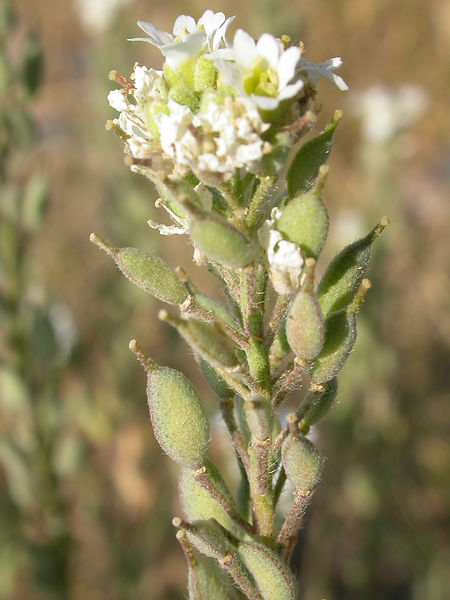
Hoary Alyssum (Berteroa incana)
Hoary alyssum is an annual to short-lived perennial forb that spreads exclusively by seed. It grows from a taproot and is commonly found in disturbed sites, pastures, hayfields, and roadsides.
Plants begin as a basal rosette, with leaves that increase in size as they mature. Basal leaves are oblanceolate (wider at the tip), typically 1–2 inches long, and have prominent light-colored midribs. Stem leaves are alternate, narrow, and angled upward along the stem. Leaf margins are entire, and leaves may appear slightly folded along the midvein.
Flowering stems are erect and range from 7 to 30 inches tall. Plants may produce a single stem or multiple stems from the base, often branching near the top. Stems and leaves are very narrow and densely covered with short, white, star-shaped hairs, giving the plant a gray-green color and rough, sandpaper-like texture.
Hoary alyssum flowers from late spring to mid-summer. Small white flowers (about 0.1 inch across) occur in racemes at the ends of branches. Each flower has four deeply lobed petals. Racemes elongate throughout the season, with lower seed pods maturing while upper flowers are still blooming.
Seeds develop in flattened, oval-shaped seedpods. Each pod contains up to seven small, round, brown seeds. The seedpods are fairly large, oval, and laterally flattened.
Hoary alyssum is toxic to horses when consumed either green or dried in hay. Symptoms may include swelling of the lower limbs, fever, stiffness, and other health complications.

Quick ID Guide
Life Cycle:
• Annual to short-lived perennial
• Reproduces by seed
Height:
• 7–30 inches tall
Roots:
• Taproot
Leaves:
• Narrow
• Alternate on the stem
• Entire margins
• Prominent pale midrib
• Covered in white, star-shaped hairs
Stems:
• Erect
• Often branched near the top
• Gray-green and rough-textured
Flowers (Late Spring–Mid Summer):
• Small, white
• Four deeply lobed petals
• Occur in elongated racemes
Seeds:
• Flattened, oval pods
• Up to 7 seeds per pod
• Brown, round seeds
Management Options
Prevention and cultural control strategies should be emphasized whenever possible. There are currently no approved biological control agents for hoary alyssum.
Because hoary alyssum has a taproot, small infestations can be effectively managed by hand pulling or digging, particularly in spring or early summer when soils are moist, and roots can be removed more easily.
Mowing, when combined with strong cultural practices that promote competitive desirable vegetation, may help suppress populations. However, mowing alone will not eradicate established infestations. Controlled grazing has generally not been effective, as livestock tend to graze more desirable forage species first.
Large infestations may require herbicide applications. Spring treatments targeting rosettes or early bolting plants are recommended for best results. Always read and follow herbicide label directions before use. Contact Sublette County Weed & Pest for assistance with herbicide selection, application rates, and timing.
