


Treatment Areas
Area 1- Lake Mountain: IN PROGRESS
Area 2- Black Canyon: IN PROGRESS
Area 3- Thompson Pass: COMPLETE
Area 4- Bronx: COMPLETE
Area 5- Big Sandy Road: COMPLETE
Area 6- Muddy Creek: COMPLETE
Area 7- Burnt Lake Rd: COMPLETE
Area 8- Boulder Lake Forest: COMPLETE
Area 9- Boulder Lake Rd: COMPLETE
Area 10- Old Town Dump: COMPLETE
Area 11- Silver Creek: COMPLETE
Area 12- Little Sandy: COMPLETE
Area 13- Scab: COMPLETE
Area 14- Boulder Creek: Unstarted: COMPLETE
Area 15- Halfmoon/ Little Halfmoon: COMPLETE
Area 16- Willow Creek Rd: COMPLETE
Area 17- Boulder Gravel Pits: COMPLETE
Area 18- Dell Creek Hill (Musk Thistle) COMPLETE
_HEIC.png)
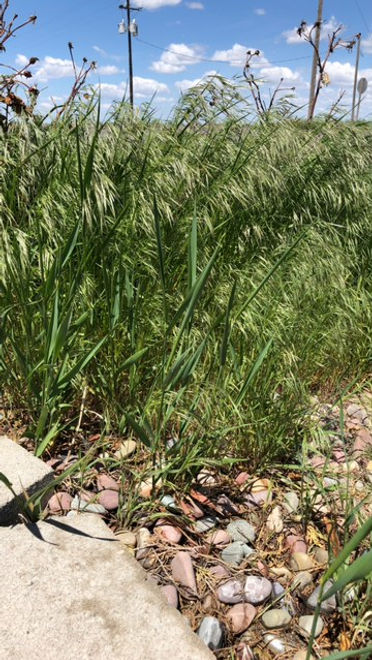
Cheatgrass, AKA Downy Brome (Bromus tectorum)
Cheatgrass is a winter annual grass that reproduces entirely by seed. It commonly establishes in disturbed areas such as roadsides, overgrazed pastures, construction sites, and wildfire scars. Once established, it can form dense stands that outcompete desirable vegetation.
Plants are typically 12–18 inches tall but may range from 4 to 30 inches depending on growing conditions. Stems are slender, erect or decumbent (lying near the ground), and covered in soft hairs that are especially noticeable early in the season.
Leaves are narrow (1–6 mm wide) and 2–6 inches long. Leaf blades are flat, often slightly twisted, and may be glabrous or covered with short, stiff hairs. Lower leaf sheaths are closed. Ligules are membranous, about 2 mm long, and fringed; auricles are absent.
Cheatgrass flowers from mid-spring to early summer. The inflorescence is a branched, drooping panicle 2–6 inches long. Spikelets contain 5–8 florets and are tipped with slender awns approximately 2 cm long. Seed heads are typically 3/8 to 3/4 inch long and often turn purple to reddish as they mature.
Early in the season, cheatgrass appears bright green. As seeds mature in late spring, plants turn red to purple, then die by early summer, leaving dense stands of blonde or tawny straw. Because cheatgrass contains high levels of silica, plant residue decomposes slowly and forms thick thatch or duff layers.
Cheatgrass has a shallow, fibrous root system. Seeds may germinate in early spring or late fall and can remain viable in the soil for up to five years. After maturity, cheatgrass becomes both a nuisance and a significant fire hazard due to its fine, continuous fuel load.

Quick ID Guide
Life Cycle:
• Winter annual
• Germinates fall or early spring
• Reproduces by seed only
Height:
• Usually 12–18 inches
• May range 4–30 inches
Stems:
• Slender
• Erect or decumbent
• Soft, fine hairs
Leaves:
• Narrow, flat blades
• Slight twist
• Soft or stiff hairs
• No auricles
Flowers (Mid-Spring–Early Summer):
• Drooping panicle
• 3/8–3/4 inch spikelets
• Purple-red at maturity
• Long awns (~2 cm)
Roots:
• Shallow, fibrous
Seeds:
• Viable up to 5 years
Management Options
Prevention and cultural control strategies should be emphasized whenever possible. Because cheatgrass seeds can remain viable for up to five years, long-term diligence and follow-up treatments (often 4–5 years) are necessary for effective control.
There are currently no approved biological control agents for cheatgrass.
Hand pulling small infestations before seed maturation is highly effective. Shallow cultivation, including hoeing or tilling immediately after germination and before flowering, can also provide good control. Mowing is not recommended, as it typically does not prevent seed production.
Large infestations often require herbicide treatment. Except for glyphosate, most herbicides used for cheatgrass control are applied preemergence to prevent germination. Preemergent products are commonly applied in late summer (often August), depending on moisture or rainfall requirements. Glyphosate is only effective on cheatgrass before seed production. Always read and follow label directions for timing and application rates. Contact Sublette County Weed & Pest for assistance with product selection and proper application timing.

