


Ventenata (Ventenata dubia)
Ventenata is a slender, erect winter annual grass and an aggressive invader of rangelands, disturbed sites, and grain crops. It is often referred to as “wire grass” due to its thin, wiry stems that are difficult to cut.
Seeds may germinate in late fall or early spring. Plants produce narrow, branching stems that range from 6 to 28 inches tall. Stems are thin, wiry, and may be glabrous or slightly hairy. Stem nodes are distinctly reddish-black to black and hairless — a key identifying feature.
Leaves are narrow (1–3 mm wide) and 2–7 cm long. Leaf blades are typically flat near the base and rolled or folded toward the tips. Ligules are membranous and may reach up to 1 cm long. Stems and the underside of leaves may have small hairs or may be smooth.
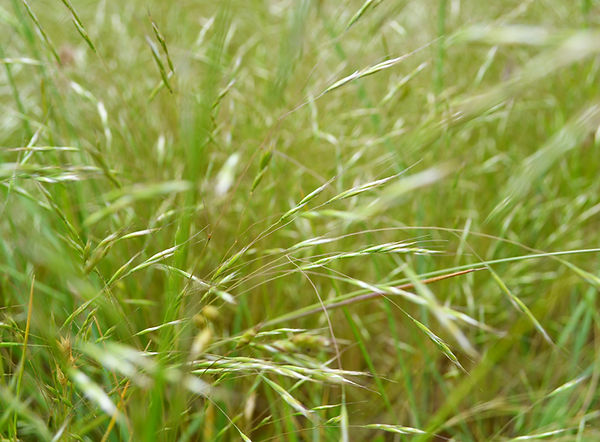
Flowering occurs from mid-spring to early summer. The inflorescence is an open, wiry panicle up to 8 inches long, with slender branches often spreading at near 90-degree angles. Spikelets occur at branch tips and typically contain three florets, each with at least one twisted awn. Awns are approximately ¾ to 1 inch long.
Seeds are formed within the awns and generally remain viable for up to two years. Ventenata develops a shallow, fibrous root system.
The plant contains high levels of silica, which slows decomposition of dead plant material and leads to dense accumulations of thatch or duff, further promoting its persistence.
Thin branching stems are naked and wiry, making the grass hard to cut, and earning it the common name “wire grass.”
Aggressive invader of rangeland and disturbed sites but also found in grain crops.
Quick ID Guide
Life Cycle:
• Winter annual
• Germinates in fall or early spring
Height:
• 6–28 inches tall
Roots:
• Shallow, fibrous
Leaves:
• Very narrow (1–3 mm wide)
• Flat at base, rolled toward tips
• Membranous ligule (up to 1 cm)
• Black to reddish-black stem nodes
Flowers (Mid-Spring–Early Summer):
• Open, wiry panicle (up to 8 inches)
• Slender branches at wide angles
• Spikelets with twisted awns
Seeds:
• ¾–1 inch awns
• Viable up to 2 years

Management Options
Prevention and cultural control strategies should be prioritized. Use certified weed-free forage and gravel, clean construction equipment before moving between sites, and clean recreational gear, clothing, and pets after recreating to prevent spread to new areas.
At this time, there are no approved biological control agents available for ventenata.
Small infestations can be effectively controlled by hand pulling prior to seed maturation. Shallow cultivation, including hoeing or tilling, can also be effective if conducted soon after germination and before flowering. Mowing is not recommended. Grazing is generally ineffective due to the plant’s high silica content, which reduces palatability.
Larger infestations may require herbicide treatment. Most herbicides, except glyphosate, should be applied as preemergent treatments to prevent germination. Application timing for preemergent products varies depending on moisture or rainfall requirements, though many are applied in late summer (often August). Glyphosate is effective only when applied prior to seed production.
Always read and follow herbicide label instructions for proper use and timing. Contact Sublette County Weed & Pest for guidance on herbicide selection, application rates, and treatment timing.

Matt Lavin Photo (Flickr)