


Sulfur cinquefoil ( Potentilla recta L.)

Sulfur cinquefoil is an herbaceous perennial commonly found in disturbed areas such as roadsides, pastures, and open fields, though it can also establish in undisturbed sites. It forms colonies and can persist once established.
Plants typically grow 1 to 1½ feet tall, though stems may reach up to 3 feet under favorable conditions. One to many erect, sturdy stems arise from a woody rootstock. Stems are generally unbranched below the flower clusters and are covered with long, perpendicular hairs. The underside of leaves, petioles, and calyx are also distinctly hairy.
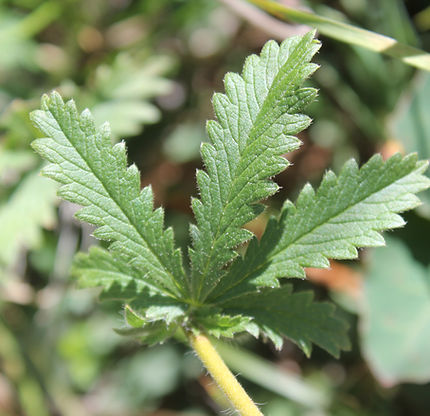
Leaves are alternate, palmately compound, and 2–4 inches long, with 5 to 7 toothed leaflets. The upper surface is green and sparsely hairy, while the underside appears green rather than silvery — a key feature that distinguishes it from many other cinquefoil species.
Flowering occurs from late spring through mid-summer (May–July). Flowers form in loose, flat-topped clusters. Each flower has five pale yellow (sulfur-colored), heart-shaped petals surrounding a darker yellow center composed of numerous stamens and pistils.
The plant develops a taproot with shallow lateral roots. Seeds are tiny, dark brown, comma-shaped achenes with light ridges or netting and narrow, winged margins.
Quick ID Guide
Life Cycle:
• Perennial
Height:
• 1–3 feet tall
Roots:
• Taproot
• Shallow lateral roots
• Woody rootstock
Leaves:
• Alternate
• Palmately compound (5–7 leaflets)
• Serrated edges
• Green underside (not silvery)
• Hairy stems and leaf undersides
Flowers (May–July):
• Pale yellow (sulfur-colored)
• 5 heart-shaped petals
• Loose, flat-topped clusters
• Darker yellow center
Seeds:
• Tiny, dark brown
• Comma-shaped
• Light ridges with narrow winged margins
Management Options
Prevention and cultural control strategies should be emphasized whenever possible. Maintaining healthy, competitive vegetation and minimizing soil disturbance can help reduce establishment and spread.
At this time, there are no approved biological control agents available for sulfur cinquefoil.
For new or small infestations, hand pulling or digging can be effective if the entire root crown is removed. Care must be taken to extract the full taproot to prevent regrowth. Mowing is not recommended, as it can stimulate lateral root development and encourage spread. Most livestock avoid sulfur cinquefoil due to its high tannin content. Goats may graze it, but their effectiveness for long-term control has not been well documented.
Larger infestations can be managed with herbicides. Spring applications help prevent flowering and seed production, while fall treatments may be more effective at targeting the root system. Always read and follow herbicide label instructions before application. Contact Sublette County Weed & Pest for assistance with herbicide selection, rates, and timing.

